The Middle East is an oil-rich region with five of the world’s 10 largest producers in terms of barrels per day. However, due in part to climate change and a demand to diversify economies, many of these countries are re-examining their economic reliance on oil and gas and are diversifying their energy sources. Some of the largest oil producers, including Iraq and Qatar, still had fewer than a 1% share of wind and solar in their energy mix as of 2023, but had plans to significantly increase this within the coming decade. Qatar, for instance, plans to achieve 18% renewable energy production by 2030, while Saudi Arabia intends to reach 50% by this time.
There are some concerns about the logistics and feasibility of these renewable energy agendas, many of which include mega projects requiring billions of dollars in investments. Only about 2.3% of the Middle East’s electricity was sourced from solar in 2023, less than half of the global average. Green hydrogen, however, could be a complementary and viable solution to reduce fossil fuel generation in the region.
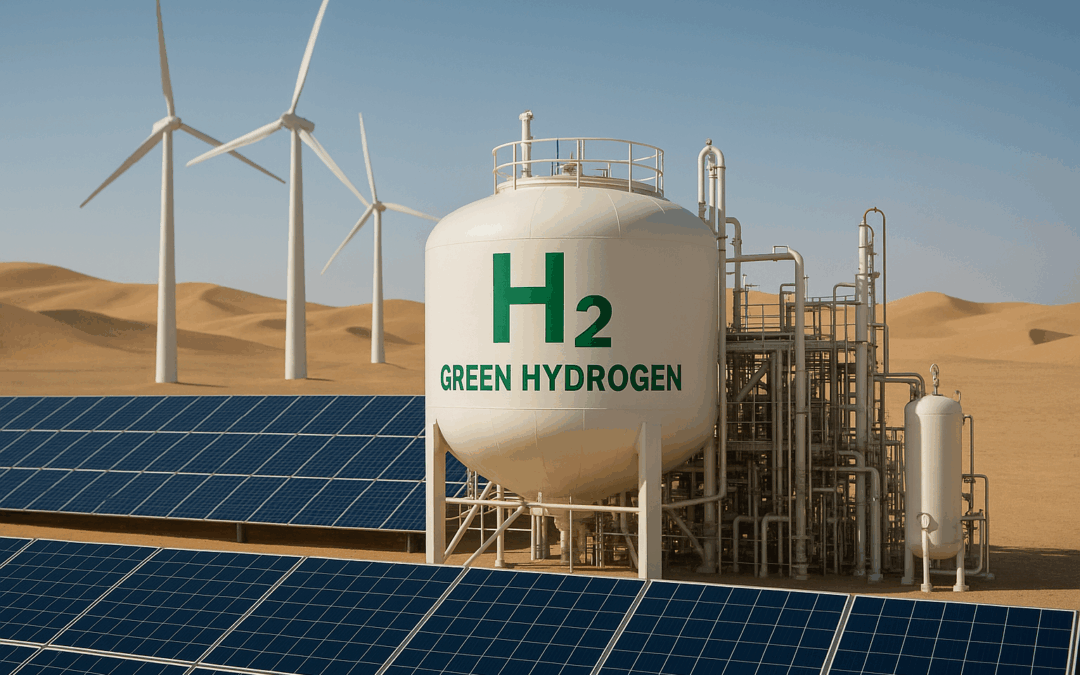
Green hydrogen is produced using solar or wind power in a process known as electrolysis, which separates the two hydrogen atoms from the oxygen atom when an electric current passes through water. The hydrogen gas can be stored and used to power modes of transportation, including vehicles and ships, and to produce ammonia for fertilizer. As of January 2025, the Middle East had more than 65 renewable hydrogen and ammonia projects in the pipeline, according to S&P Global Commodity Insights.
“We see the MENA region leading the development of green hydrogen,” said Dr. Nikunj Gupta, VP of hydrogen studies at Abu Dhabi National Oil Company, during the Green Hydrogen Summit 2023. “This is the energy hub of the world. There’s also the infrastructure to process energy molecules, the engineering capabilities, the shipping infrastructure—it’s all available and most of it can be utilized.”
Below are some of the key green hydrogen projects in the Middle East.
Blue Ammonia Plant in Qatar
Qatar, in 2024, broke ground on a $1.2 billion, low-carbon blue ammonia plant expected to be the largest of its kind when complete in 2026. Situated in Mesaieed Industrial City, the facility will have an ammonia production unit capable of producing 1.2 million tonnes per annum (mtpa) and a CO2 injection and storage unit. The plant will be powered via solar energy from another in-development clean energy project in the industrial city.
Blue ammonia, a key ingredient in fertilizers, can be shipped and converted into hydrogen, allowing other countries to reduce carbon emissions in farming practices. The new plant’s strategic location, near one of the Middle East’s largest petrochemical export facilities, will allow for a seamless delivery of blue ammonia. The on-site storage facility, meanwhile, is expected to have a capacity of 1.5 mtpa.
Oman’s Green Hydrogen Projects
Of the Middle East’s 10 low-carbon hydrogen plants either active or expected to be complete by 2030, five are in Oman. The country, with its strategic location near global shipping routes and renewable energy potential, has attracted investments from international companies, like Électricité de France SA, Copenhagen Infrastructure Partners KS, and Samsung E&A Co Ltd.
The ACME Duqm Hydrogen Project Phase 2, with an expected capacity of 0.497 mtpa, is Oman’s biggest green hydrogen project. ACME Cleantech Solutions Pvt Ltd. is leading construction efforts and the plant, which will be powered by solar energy, is expected to be operational by 2028. Another major initiative, the POSCO Consortium Duqm Hydrogen Project, is expected to launch by 2030. It has a projected capacity of 0.22 mtpa.
NEOM in Saudi Arabia
Saudi Arabia has a regional competitive advantage in green hydrogen as it can produce it at the most cost-effective rate. Given this, it’s no surprise the kingdom had more than $10 billion committed to green hydrogen projects as of 2022. The 2.2GW project in Neom, a planned futuristic city in Tabuk Province, is the largest and most significant of these. Neom, ACWA Power, and Air Products signed the landmark $5 billion agreement to build the world’s largest green hydrogen project in 2020, with the goal of exporting the energy source to global markets.
The Neom plant will be powered by a combination of wind and solar and produce as much as 1.2 mtpa of green ammonia, as well as 650 tons of hydrogen per day. It was originally scheduled to be operational by 2025, but has been pushed back in part due to rising costs; the budget increased from $5 billion to $8.5 billion in 2023 as a result of inflation and land fees.
Jazan IGCC Complex Saudi Arabia is also developing a $12 billion facility that will produce hydrogen, steam, and power. The Jazan IGCC Complex, owned and to be operated by a joint venture consisting of Saudi Aramco, ACWA Power, and Air Products, will produce 3.8GW of gross power, 184,000 Nm3/hr of hydrogen, and 580,000 tph of steam.