
Despite all of the logistical and weather-related concerns leading up to the 2022 FIFA World Cup in Qatar, the quadrennial football tournament was an astounding success and may even be remembered as one of the greatest World Cups of all-time. There were a record 172 goals scored in the tournament, and the final between Argentina and France has been called one of the best-ever World Cup matches. French star Kylian Mbappe scored three goals in the final, becoming the first player to do so since Geoff Hurst in 1966. However, it wasn’t enough, as Lionel Messi—arguably the best player in the world—led Argentina to a 4-3 win via penalties.
The event was also an undeniable success for Qatar, fueling tourism-related revenue growth and adding billions of dollars to the economy. However, Qatar spent substantially more than any other country that has hosted the World Cup, building seven new world-class stadiums costing more than a combined $6.5 billion. Hoping to keep these venues from becoming “white elephants,” relatively abandoned sites like those in Russia, South Africa, and other previous World Cup hosts, Qatar had ambitious plans to reuse and repurpose them.
Here’s a look at what has happened with those seven stadiums nearly three years removed from the World Cup.
- Stadium 974
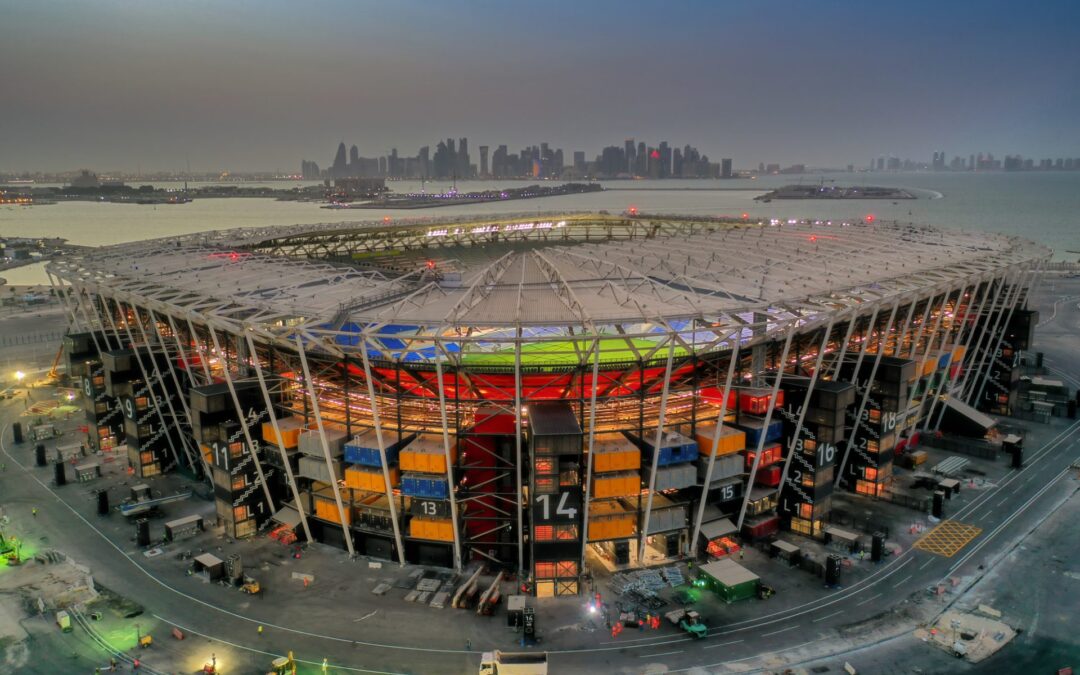
Built from 974 shipping containers just outside of Doha, Stadium 974—a nod to Qatar’s country code—was the first planned temporary facility in World Cup history. The idea behind the unique design, according to Spanish architectural firm Fenwick Iribarren Architects, was to avoid building a “white elephant.” The original plan was to take apart the stadium and reassemble it at a future World Cup host site, potentially in the US, in 2026. However, by the end of 2024 the stadium was still standing, occasionally hosting concerts and football matches,
Stadium 974 hosted a pair of matches in the 2024 FIFA Intercontinental Cup and, on January 5, 2025, attracted nearly 40,000 people for the final of the 29th edition of the French Super Cup between Paris Saint-Germain and AS Monaco. Mark Fenwick, who designed the stadium, said during a November 2024 interview that the stadium would soon be dismantled and moved, but hinted it wouldn’t relocate to the US, as this would require an overhaul of the entire electrical system.
- Education City Stadium
Built near several university campuses in Qatar’s Education City, the 40,000-seat Education City Stadium cost $700 million to build and hosted several group stage matches and the quarter-final match between Croatia and Brazil. Fenwick Iribarren Architects designed the venue.
Following the World Cup, the stadium’s capacity was reduced to 25,000. It has primarily been used by the surrounding universities. However, it did host six matches in the 2023 AFC Asian Cup.
- Lusail Stadium
Lusail Stadium hosted the World Cup final and, with a capacity of 88,966, is the second-largest stadium in Asia. It was supposed to be repurposed into a smaller venue (with seating reduced to 40,000) and community hub with hotels, shopping malls, and cafes following the World Cup, but those plans have been delayed. Instead, it has since hosted the first and final match of the 2023 AFC Asian Cup and the final of the 2024 FIFA Intercontinental Cup.
- Al Bayt Stadium
The most expensive stadium to build at around $874 million, Al Bayt Stadium was built about 35 kilometers outside of Doha by Qatari contractor Galfar Al Misnad and Italian firm Webuild S.p.A. It hosted nine World Cup matches, including the opening match between Qatar and Ecuador, and the France-Morocco semi-final. More recently, it hosted four matches in the 2023 AFC Asian Cup.
The sustainably-built stadium has a retractable roof and luxury hotel suites with balcony views of the pitch. It was also supposed to have been repurposed into a community hub following the World Cup, but there has been no progress in that regard.
- Al Thumama Stadium
Built near Hamad International Airport, Al Thumana Stadium hosted eight matches, including the Morocco-Portugal quarter-final, in the 2022 World Cup. It was also one of nine venues for the 2023 AFC Asian Cup. Qatar is in the process of transforming the 44,000-seat stadium into a mixed-use venue.
- Ahmad bin Ali Stadium
Ahmad bin Ali Stadium hosted seven matches, including the Argentina-Australia Round of 16 match, at the 2022 World Cup. Named after the Emir of Qatar (from 1960-72), the stadium has a seating capacity of 45,032, but is expected to be reduced to around 21,000 in the near future. It primarily hosts football matches. Ahmad bin Ali Stadium hosted seven matches, including the Jordan-South Korea semi-final, at the 2023 AFC Asian Cup, and is the home pitch for Al-Rayyan Sports Club.
- Al Janoub Stadium
Al Janoub Stadium is another association football venue that now serves as the home pitch for Qatar Stars League club Al-Wakrah SC. The stadium, which has a retractable-roof, had a capacity of 44,325 during the World Cup and hosted seven matches, including the Japan-Croatia match in the Round of 16. It now has a capacity of 20,000 due to the removal and donation of seats to football venues in Africa.