
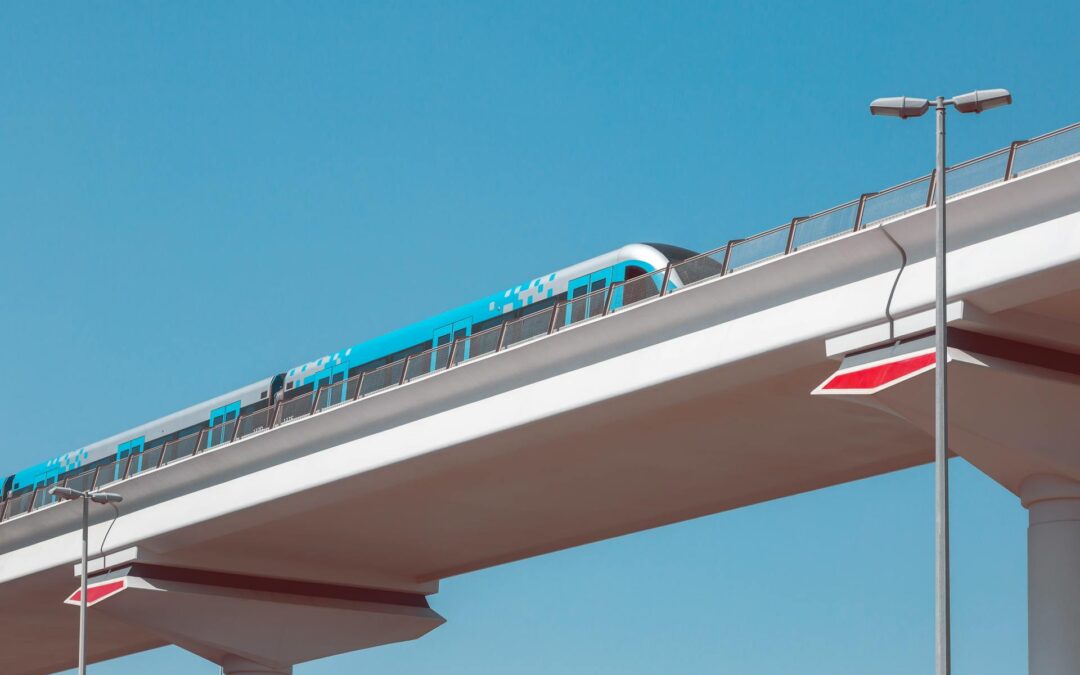
In many parts of the world, high-speed rail networks offer quick travel in and between major cities, reducing traffic congestion and potentially providing environmental benefits. Japan’s legendary rail system is known for its punctual and comfortable passenger cars. It transports thousands of commuters to and from work each day, while Europe’s railway network allows people to seamlessly travel between countries.
Despite an abundance of megaprojects in Saudi Arabia, the United Arab Emirates (UAE), and Qatar, high-speed railway passenger travel in the Middle East is still in its early stages. There have been some successes, like the nearly 450-kilometer Haramain High Speed Railway that runs between the holy cities of Mecca and Medina, but many projects have been delayed due to logistical and financing issues.
Here’s an update on the progress of some of the most ambitious high-speed rail projects in the Middle East and the challenges affecting their completion.
Etihad Rail
Etihad Rail is the most ambitious ongoing high-speed railway project in the Middle East. The UAE’s national railway, once finished, will connect all seven emirates over more than 1,200 kilometers. There are also plans for it to link with the five neighboring Gulf countries—Saudi Arabia, Bahrain, Kuwait, Oman, and Qatar—via the Gulf Cooperation Council (GCC) railway network. It has been in development since 2009, with a 264-kilometer freight line opening in 2016.
Passenger service for the remainder of the line is expected to be available by the end of 2026, with a planned roll out in multiple stages. The first stage will feature operational passenger travel between Abu Dhabi, Dubai, Fujairah, and Sharjah. The other three emirates—Umm Al Quwain, Ras Al Khaimah, and Ajman—will be subsequently connected to the network, including integration with existing public transport systems.
Thirteen trains, each with a capacity of 400 passengers, will run on the network, serving up to 36.5 million people each year by 2030. Trains can go as fast as 300 km/h, making the trip from Abu Dhabi to Fujairah about 1 hour and 40 minutes. As an energy-efficient alternative to road travel, the rail network has been constructed with an emphasis on sustainability and will help the UAE meet its Net Zero by 2050 initiative.
GCC Delays
Early skeptics of the Etihad Rail may have pointed to the more ambitious and long-delayed GCC Railway. The Gulf nations announced the $250 billion project, spanning more than 2,100 kilometers, in 2009, at which point Saudi Arabia was the only GCC nation with railway infrastructure. The six member nations planned to complete the project within a decade, but construction had yet to begin by 2024.
Low crude prices and the pandemic hindered the project significantly, but the lack of cohesion among the six GCC nations has also been an obstacle. Because the states act independently, their economic agendas often conflict with other members. Many have chosen to focus on domestic rail networks rather than building their portion of the Gulf Railway.
“It’s the cohesion among the sovereign parties and prioritization of the project,” said Karen E. Young, director of the Middle East Institute’s Program on Economics and Energy, speaking to Fast Company about the GCC Railway’s biggest obstacle. “The GCC stumbled on cohesive economic policy cohesion for some time, and this project is, in many ways, an example of that.”
The Tehran–Qom–Isfahan Line in Iran
Iran, meanwhile, launched its first high-speed rail line in early 2025, about a decade after construction began. The Tehran–Qom–Isfahan line, overseen by the China Railway Engineering Company, spans 410 kilometers with a passenger train operating speed of about 250 km/h. Designed to reduce travel time between Isfahan and Tehran, it has an annual capacity of 16 million passengers.
Prioritizing Air Travel
Depending on the route, air travel can be quicker than high-speed rail in the Middle East. For instance, it’s faster to travel from Jeddah to Dubai by plane. Shorter trips, like from Doha to Abu Dhabi, might be more convenient and quicker by rail. Not surprisingly, state investors are thus prioritizing airport development over rail networks.
According to analytics company Global Data, there were nearly 50 airport expansion, renovation, and new construction projects ongoing in the Arabian Gulf as of January 2025. These had a combined value of $182.6 billion and include a $35 billion, 400-gate terminal at Al Maktoum International Airport in Dubai and the planned $50 billion King Salman International Airport in Riyadh.
Other Challenges
Building new public transportation infrastructure is a massive undertaking on its own, let alone when requiring the cooperation of six countries with conflicting interests. Securing approval and financing can be difficult. Creating sufficient space for these systems, which often includes restructuring existing road infrastructure and navigating safety concerns, is even more complex.
Constructing high-speed rail lines across desert landscapes isn’t without its challenges, either. The Spanish-led consortium building the final phase of the Haramain High Speed Railway had to construct retaining walls and ditches near the line to keep sand off the track bed, which could harm the rail-wheel interface. Despite these hurdles, railroad development in the Middle East is proceeding. The projects mentioned above—and the many other passenger and freight rail initiatives across the region—will enhance key transportation networks, deliver economic benefits, and improve quality of life for the growing Middle East population.